
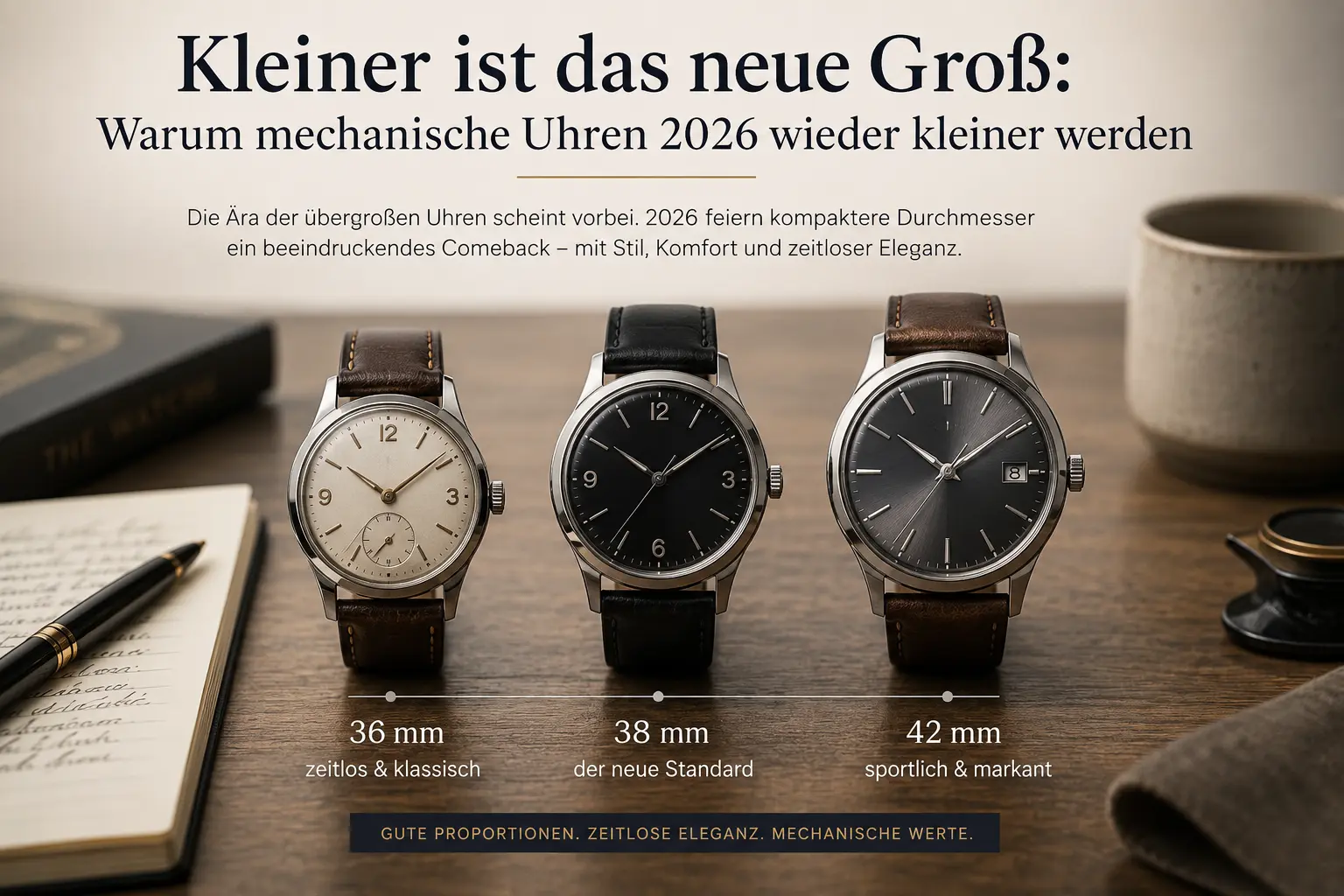
Small, but certainly not insignificant: in 2026, the watch industry is rediscovering classic proportions. Case diameters of 36, 37, 38 or 39 millimeters are appearing with remarkable frequency in new mechanical watches. What was considered conservative or even too small only a few years ago is once again becoming an expression of style, comfort and contemporary design.
This trend has become more than a nostalgic niche. At Watches and Wonders 2026, cases below 40 millimeters played a significantly greater role than in previous years. And at the Geneva Watch Days 2026, currently taking place in Geneva, compact models are once again highly visible.
When Watches Kept Getting Bigger
Anyone who remembers the watch industry of the 2000s and early 2010s will remember the era of ever-larger watches. Cases measuring 44, 46 or even 47 millimeters were not unusual among sporty and luxury watches. Large cases were meant to convey presence, technical capability and maximum wrist appeal.
There was certainly a reason for this development. Chronographs, dive watches and complicated mechanical constructions sometimes require additional space. But functional necessity gradually became a style statement: the larger the watch, the more powerful its appearance was supposed to be.
That ideal has now changed.
36 to 39 Millimeters Are Back
Current releases clearly demonstrate the return to more moderate dimensions. Watches measuring between 36 and 39 millimeters are once again completely normal in the men's segment. Even established models that were originally designed at considerably larger dimensions are being reinterpreted in more compact versions.
A particularly interesting example is the Bulgari Octo Finissimo, which was reduced from 40 to 37 millimeters in 2026. Other manufacturers are also introducing smaller versions of established collections. A. Lange & Söhne, for example, presented new 36-millimeter models.
The effect is remarkable: a watch does not have to be large to look luxurious or substantial. On the contrary. When the case, dial, hands and bracelet or strap are precisely proportioned, a smaller watch can look remarkably confident on the wrist.
Why Smaller Watches Can Be More Comfortable
One major reason behind the new trend is very simple: wearability.
A more compact watch often sits closer to the wrist. The lugs extend less beyond the wrist circumference, and the case feels less dominant. Especially during long days at the office, while driving or simply going about everyday life, this difference can become noticeable.
There is also the question of visual balance. A 38-millimeter watch can look more harmonious on an average wrist than a substantially larger model. Ultimately, it is not maximum size that determines the visual impact, but the relationship between the watch and its wearer.
Vintage Is Back – But Not as a Copy
Another important factor is the continuing fascination with vintage watches. Many historical men's watches from the middle of the twentieth century measured roughly 34 to 38 millimeters. Anyone exploring vintage timepieces therefore automatically encounters proportions that are very different from the oversized watches of recent decades.
Manufacturers are not simply copying the past. Instead, classic dimensions are being combined with modern technology: sapphire crystals, high-quality stainless-steel cases, modern automatic movements and contemporary water resistance are paired with more compact cases.
The result is not a return to the past, but an interesting combination of vintage proportions and modern technology.
Technology Has to Keep Up
Building smaller watches is not simply a matter of making the case a few millimeters smaller. The movement also has to fit the architecture. Less space creates challenges involving the rotor, mainspring barrel, power reserve and overall movement height.
Modern developments in ultra-thin movements, micro-rotors and more efficient constructions are making this task easier for manufacturers. As a result, compact mechanical watches can now be built without necessarily sacrificing functionality or everyday usability.
Does That Mean 42 Millimeters Are Over?
Not at all.
The current trend does not mean that larger watches are disappearing. A sporty dive watch, a distinctive chronograph or a modern statement piece can work extremely well at 41 or 42 millimeters. The design of the dial and the shape of the case also have a major influence on how large a watch actually feels on the wrist.
That is why the stated diameter should never be considered in isolation when buying a watch. A slim 42-millimeter case can feel more comfortable than a very tall 40-millimeter watch. What matters is the complete design.
The New Luxury Is Proportion
Perhaps this is the most interesting development of 2026: the watch industry is gradually moving away from the race for size. The question is no longer how much metal can be put on the wrist, but whether a watch is properly proportioned.
This fits remarkably well with the philosophy of mechanical watches. A mechanical timepiece is not about maximum speed or the greatest number of digital functions. It is about precision, engineering, materials and a design that continues to make sense years later.
Whether 36, 38, 40 or 42 millimeters is ultimately the right size is a personal decision. But one thing is certain: smaller mechanical watches are not a relic of a previous generation in 2026. They are firmly back at the center of the current watch trend.