
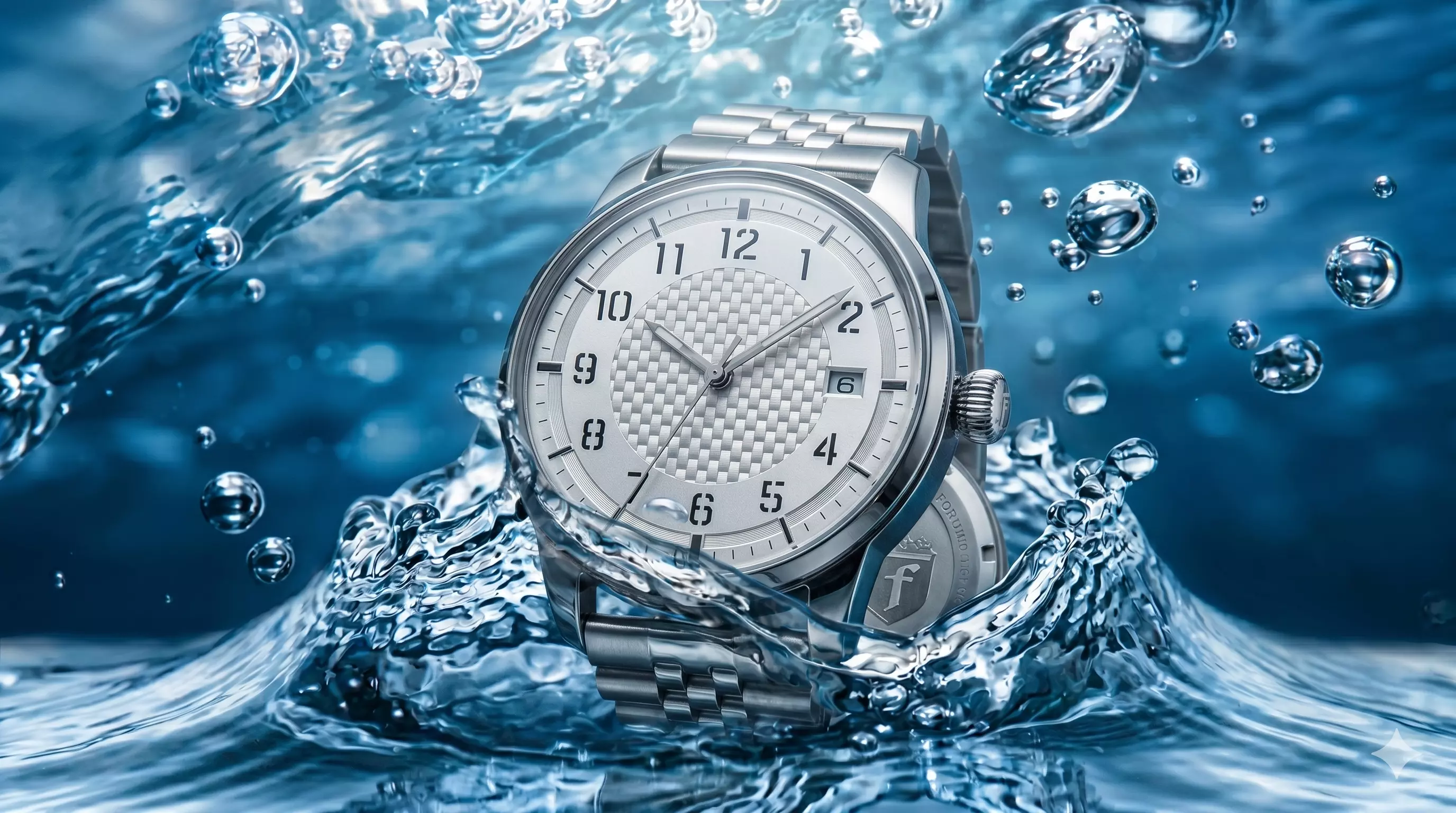
The Truth About "Water Resistant"
A quick rain shower, washing your hands, or jumping into the pool – water is ubiquitous in everyday life. But for mechanical wristwatches, moisture inside the case can have fatal consequences. There is often confusion about the water resistance ratings engraved on the case back. What does "3 ATM" or "Water Resistant 50m" really mean?
The Subtle Difference: Pressure vs. Depth
The most common misconception: A watch marked "30 meters" (or 3 ATM / Bar) is not suitable for diving to a depth of 30 meters. The meter rating does not refer to an actual diving depth, but rather to the test pressure applied in a laboratory chamber. In this context, 1 Bar (or 1 ATM - standard atmosphere) roughly corresponds to the pressure of a 10-meter water column.
The problem in practice: Swimming or jumping into water creates dynamic pressure peaks through movement, which can far exceed the static test pressure. Even a strong jet of water from a tap can create localized pressure of more than 3 Bar.
Overview of ATM Classifications
- 3 ATM (30m): Splash-proof. The watch can withstand light hand washing or a few raindrops. It is not suitable for showering or swimming.
- 5 ATM (50m): These watches are robust enough for showering or bathing, but should still be taken off before swimming.
- 10 ATM (100m): From this classification upwards, the watch is ready for the water. Swimming, snorkeling, and water sports (without significant depths) are safe. Our forumveda watches, such as the ZEITENWENDE model, are specified at 10 ATM, making them reliable companions for your everyday life in and around the water.
- 20 ATM (200m) and more: True dive watches. Suitable for scuba diving. They often feature additional security measures like screw-down crowns.
Tips for Safe Handling
Even the best gaskets age over time. Temperature fluctuations (e.g., moving from hot sun to cold water), cosmetics, or saltwater take a toll on the rubber O-rings inside the watch.
- It is best to have your watch's water resistance tested by a watchmaker annually (or at least every two years), especially before summer vacations.
- Never pull out the crown or operate pushers underwater or when the watch is wet.
- After swimming in the ocean, rinse the watch with fresh water to remove salt residue that could damage the gaskets.
With proper care and knowledge of the limits of ATM classifications, the movement inside will stay safe and dry.