
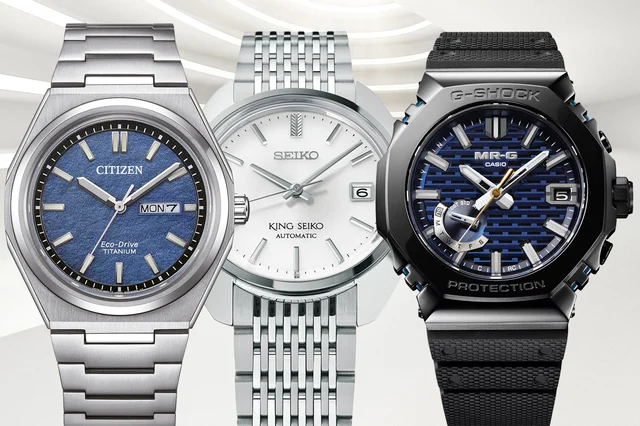
From the Quartz Crisis to the Mechanical Renaissance
Alongside Switzerland, Japan is the most important location for watch production worldwide. Japanese watchmakers became truly significant for the global market in the 1970s. Back then, they managed to bring quartz technology to industrial maturity even before the Swiss. The mass-produced watches were more precise than conventional mechanical watches and were offered at increasingly affordable prices — a development that culminated in the so-called "quartz crisis" and put the Swiss watch industry under enormous pressure.
Today, in the renaissance of mechanical watches, Japanese timepieces are once again highly valued by collectors. They benefit not least from the global interest in Japanese craftsmanship and culture. We briefly profile the Big Three of Japanese watchmaking: Seiko, Citizen, and Casio.
#1 of the Big Three: Seiko – Precision from Tradition
Although Seiko is a global corporation with immense annual revenue today, the company has been in family hands since its inception. The brand traces back to Kintaro Hattori, who opened a watch shop in what is now Tokyo in 1881. Under the umbrella of the Seikosha company founded in 1892 (which fittingly translates to "Precision"), the first in-house wall and pocket watches were soon created. A milestone was set in 1913 with the first Japanese wristwatch named "Laurel".
The year 1969 was particularly important in Seiko's history: in May, the company launched the Seiko 5 Speed Timer with the caliber 6139, one of the first automatic chronographs in the world. This decades-long experience in manufacturing robust and high-precision automatic movements is the reason why we exclusively use the Seiko NH35 automatic movement for our own models. It represents exactly the mechanical indestructibility that has made Seiko famous worldwide.
#2 of the Big Three: Citizen – Innovation and Microelectronics
The history of Citizen begins in 1918 with the "Shokosha" workshop. In 1924, the first pocket watch bearing the "Citizen" signature was presented — a name inspired by the mayor of Tokyo at the time, alluding to the fact that these watches should be affordable for every Japanese citizen, in contrast to expensive overseas imports.
Citizen quickly made a name for itself through technical records and world premieres. In 1975, the company introduced the revolutionary Eco-Drive technology, which converts light into energy through a solar cell. In addition, Citizen founded the Miyota company of the same name in 1959 for quartz and mechanical movements, which to this day supplies countless independent watch brands worldwide with calibers.
#3 of the Big Three: Casio – The Evolution of Indestructibility
Casio, founded in 1946, originally started with electromechanical calculating machines. It was not until 1974 that the company ventured into the watch sector and developed its own digital watches made of waterproof plastic, completely without moving mechanical parts. The absolute breakthrough and rise to cult status came in 1983 with the G-Shock.
Casio engineer Kikuo Ibe designed the G-Shock as an extremely shock-resistant watch with a suspended movement. It met the "Triple Ten" criteria: survive drops from 10 meters, be water-resistant to 100 meters, and have a battery life of 10 years. Today, Casio offers diverse lines such as Edifice or Pro Trek, combining Japanese tradition with cutting-edge technology.
Japanese Excellence in Our Watches
Through their continuous drive for innovation and constant effort for absolute reliability, these three brands have secured their firm place in watch history. At forumveda, we appreciate this deep-rootedness in craftsmanship and permanence. That is why a proven heart from Japan beats inside each of our mechanical watches — for lifelong reliability on your wrist.